What do I need to know about it?
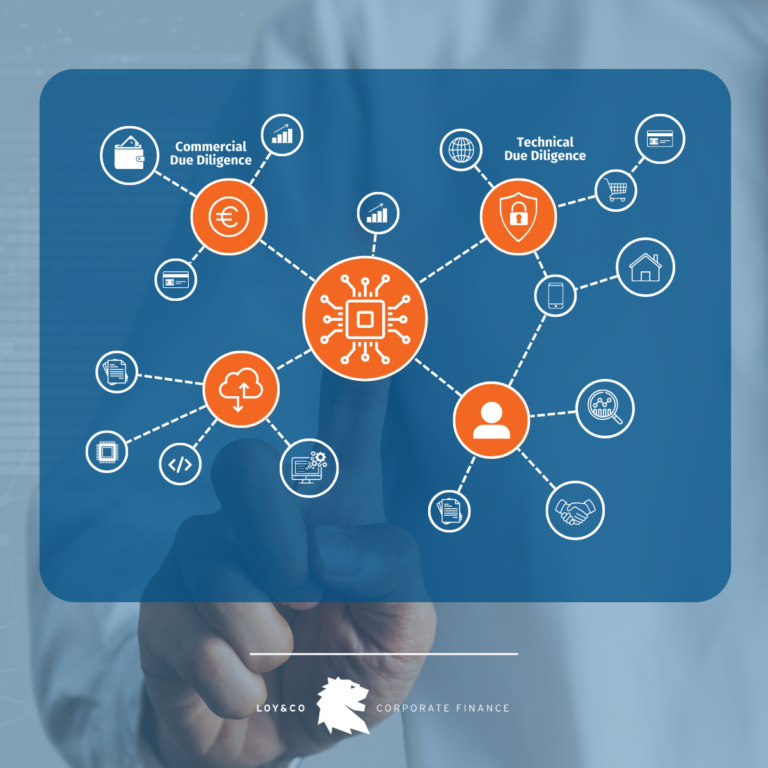
Commercial Due Diligence (CDD) Analyses
Commercial Due Diligence (CDD) describes a comprehensive analysis of a company with regard to all business and strategic issues. A CDD includes, at a minimum, the analyses listed below. You may also notice some of the previously discussed key metrics for software companies:
- Market and Competitive Analysis: This involves defining and thoroughly examining the market in which the company operates. This includes identifying market trends, growth opportunities, barriers to entry, competitors, market shares, and the regulatory framework.
- Customer Analysis: The company’s main customers are analyzed, their customer loyalty levels (CLV, ARR), and their dependence on a few large customers.
- Product and Service Portfolio: The company’s products and services are evaluated to determine their competitiveness, unique selling propositions (“USP”), innovative strength, and potential development opportunities.
- Sales and Marketing Strategy: The company’s distribution channels, sales strategies, and marketing activities are reviewed to assess the effectiveness and efficiency of these approaches (CAC).
- Management and Organization: The company’s leadership is evaluated to ensure that the company has the necessary management talent to address future challenges.
- Risk Assessment: Potential business risks such as legal, financial, or operational risks are identified and assessed.
In addition to market and product aspects, which are not typically part of financial due diligence, CDD analyses tend to be more forward-looking. CDD often aims to define your company’s value drivers from historical key figures, which can be used to validate your business plan or to revise it for the buyer.
Technical Due Diligence (TDD) Analyses
Technical Due Diligence or Technology Due Diligence (TDD) encompasses the analysis of your company’s technological platform as well as its IT and data strategy and is typically particularly relevant for software companies. The following outlines the scope of TDD based on the example of the consulting firm OMMAX, which specializes in IT companies.
- Technology and Product Strategy: The first module covers the description of a company’s technology and product role in the context of its business and growth strategy, as well as the evaluation of its IT roadmap, including coverage, schedules, and priorities.
- IT Infrastructure and System Architecture: The second module evaluates the software architecture and scalability of the tool stack, including code documentation (“code review”) and technical debt, as well as the front- and back-end infrastructure with regard to interoperability and scalability.
- Software Development Lifecycle: The third module evaluates the multi-component tech stack and analyzes the development processes and tech stack, including documentation and the degree of automation, for the development and maintenance of the company’s systems and infrastructure.
- Team and Organization: The Team and Organization module examines the structure of the IT team, including the external parties involved, and how the competencies of the development team to support the company’s business and growth strategy.
- IT Security & Compliance: This examines existing security measures, including documentation and the current status of business continuity planning and disaster recovery planning.
- Technical Finance: Module six breaks down CapEx and OpEx expenditures by key product areas, including a commentary on their alignment with the company’s growth plans and comparable figures from competitors and the industry.
- Data Model and Quality: The final module describes factors such as the current data model, data architecture, and relevant systems, provides an overview of the collected data, and analyzes the data inventory and data quality in relation to their impact on the business.
Other Software-Specific Topics
Finally, there are some specific considerations that often play a role, particularly for software companies, in the context of CDD or TDD. These essentially include:
- Technological Audit: Since software companies are heavily dependent on their technology, a thorough review of the technology platform, development process, IP rights, and technological innovations is crucial.
- Licensing and Compliance: Reviewing software licenses, open source usage, and legal compliance aspects is particularly important to minimize legal risks.
- Dependency on Skilled Workers: Software companies often rely heavily on talented developers and skilled workers. Assessing their workforce and retention is therefore crucial.