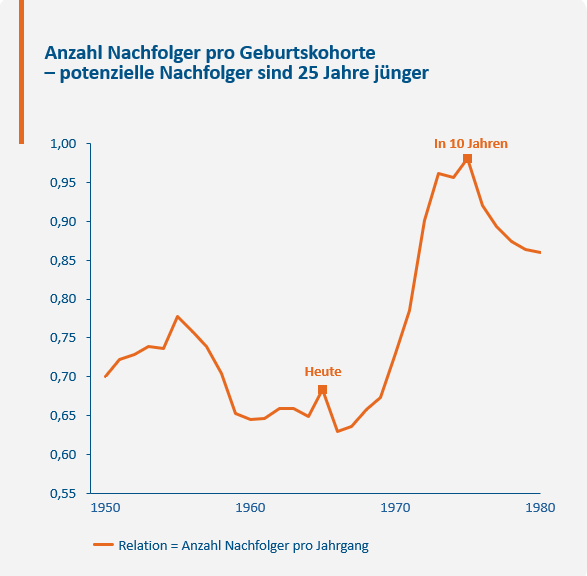
Currently, for every ten entrepreneurs of the 1965 generation, there are only around seven potential successors of the 1990 generation. This unfavorable ratio of 0.7 is a key reason why many companies today cannot find a suitable successor. Micro and small businesses are particularly affected, where orderly succession is often difficult for other reasons as well.
As part of our research, we conducted an analysis in which we examined birth cohorts, generational change, and their long-term effects on the succession landscape. The results provide interesting and sometimes surprising insights for understanding current market dynamics. We based our analysis on the following assumptions: Entrepreneurial responsibility is exercised for an average of around 25 years. Business succession typically occurs around the age of 60, while potential successors are on average 25 years younger.
While a total of around 13 million children were born in the decade between 1960 and 1970, the number fell to just 8.5 million between 1985 and 1994 – 25 years later. This corresponds to an average ratio of 0.6.
In the successor cohort 1995 to 2004, the number was 7.6 million. The ratio improves to an average of 0.9.
For the sixty-year-olds in 2035 (born in 1975), who are expected to retire from their business in ten years, a similarly large cohort of 35-year-olds (born in 2000) will be available as potential successors. This means that there will be one successor for every entrepreneur willing to hand over the business.
Afterward, however, the ratio will deteriorate slightly again.
What concrete implications does the demographic gap that will continue to exist in the coming years have for companies?